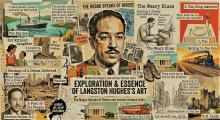
At the beginning of his autobiography, "The Big Sea", Langston Hughes evoked an experiment that would prove decisive for the rest of his career. Perhaps no other gesture characterizes better the artistically singular and resolutely anti-intellectual personality of this author than that of the 21-year-old man who, after turning his back on New York and Columbia University, embarks on a cargo ship bound for Africa and, in a symbolic act of liberation - throwing all his school and university books off the Atlantic - frees himself from the influence of his father, obsessed with social and economic success. Despite this seemingly anti-literary position, Hughes became one of the most influential and prolific authors of African-American literature of the twentieth century. His considerable work includes, among others, numerous collections of poetry. Two novels, short stories, nine plays (including the great success Mulâtre, 1935), several one-act plays, booklets of musical comedies and operas, an autobiography in two volumes and translations of works by Jacques Roumain, Nicolás Guillén and Federico García Lorca. The author also distinguished himself as the publisher of several anthologies, including the much appreciated Book of Negro Folklore (1958).
Unlike the young Gwendolyn Brooks, whose he was the mentor at a certain time he once mentored and whose poetic development he greatly influenced, Hughes's poetry did not experience any decisive break, either in substance or form. As critic Arthur P. Davis described it, Hughes possessed an exceptional talent for a simple and concise style. Although he sometimes resorted to traditional metric forms, the free verse, mostly without rhymes, was perfectly suited to his spontaneous and contextual method of work. His models, by his own admission, were, in addition to Walt Whitman, mainly Carl Sandburg, Vachel Lindsay and Edgar Lee Masters. However, his unwavering attachment to the African-American language and culture was far more decisive than the contemporary avant-garde. Not only did Hughes systematically reject a symbolically enigmatic style, characteristic of the influential current of the "New Criticism," but he also strongly defended a poetry oriented towards the concerns and language of the black working class. In particular, the shape and atmosphere of the blues, a central element of urban black culture, repeatedly defines its poems.
As he notes in the preface to his second collection of poetry "Fine Clothes to the Jew", (1927), 17 poems from this collection are composed in the style of African-American blues. This style largely determines the metric structure of these worms. Like the blues, the first verse, thematically the most important of the three-verse strophe, is repeated, the next third verse being bound to the first two by a final rhyme. In his later works, Hughes expanded the rigid model of blues and formally adopted the freer and more syncopated structure of contemporary jazz, notably "cool jazz" and "be-bop." Early signs of this evolution can already be found in "Montage of a Dream Deferred," 1951 (eponymous poem: "What Will Become of the Deferred Dream? , "2002, E. Hesse, ed. N. Elrod). Between the opening poem "Dream Boogie" and the last verse of the collection, which takes up the original chorus ("a delayed dream"), the leitmotif of the "unassailable dream" is explored through ever-new variations, painting a striking picture of the inhabitants of Harlem, often desperate but unshakeable. Their philosophy of life - "laugh not to cry" - is grasped with great finesse as to the tragi-comic dimension of African-American culture. In Ask Your Mama. 12 Moods for Jazz (1961), Hughes had provided detailed instructions for each poem for musical accompaniment, which led some critics to consider him the father of the "Poetry-Jazz" movement.
From the point of view of the themes discussed, Hughes's poetry is divided into several categories: poems on Harlem; poems dealing with African roots of African Americans; poems committed to social significance; and blues poetry. These themes are present, with varying importance, in all his publications, with the exception of the collections * Fine Clothes to a Jew *, * Montage of a Dream Deferred * and * Ask Your Mama *, which focus on Harlem and blues respectively.
As his autobiography also shows, Hughes's perspective, despite his close ties with African-American culture, was more humanist and universal than ethno-political. He could not resolve a general condemnation of the black middle class and its efforts at integration - see "Low to High" and "High to Low" - nor an unqualified denunciation of the socially dominant white population. His point of view was characterized by support for the oppressed, but also by great justice and a deep understanding of the human condition. In his youth poem "Cross," he even suggests an understanding and a willingness to forgive the "original sin" of white America, namely slavery and the resulting racial mixing. This attitude also explains Hughes' intellectual relationship with the great poet of American democracy, Walt Whitman. Hughes, who, despite his sympathies for the Soviet Union, was never a radical communist, believed in the principles of the American Constitution, whose respect was indispensable for a free and harmonious coexistence between blacks and whites. Thus, the almost imperceptible "but not so long" of the last verse of "Tomorrow's Plow," 1943 ("Der Freiheit Pflugscharren," 2002, N. Elrod), evokes unequivocally the vision of a better and fairer America, as also expressed in Martin's famous speech "I Have a Dream." Luther King, 1963. Among the poems that deal with Africa and the spiritual ties of African-Americans with the "mother country" is the famous "The Negro Speaks of Rivers," 1921, published in the first collection of poems, * The Weary Blues, * in 1926. Here, by analogy with the mythical and timeless patience and wisdom of the historical rivers of the Nile, Congo and Mississippi, the shared suffering and human greatness of all blacks are invoked.
The concept of a somewhat vague spiritual "negritude," palpable in many of these poems - for example in "Chanant du soleil," "Danse africaine" and "Negro" ("Das Lied der Sonne," "Afrikanischer Tanz," "Neger," 2002, N. Elrod) - has sometimes been described as "ethno-romanticism" by criticism. However, given that the black minority in the United States has long been excluded from American national history, a return to sources, stimulated in the 1920s by Marcus Garvey's prominent figure and his Afrocentric movement "Return to Africa," seems quite understandable.
Also noteworthy is "One-Way Ticket" (1949), a collection of poems about Alberta K. Johnson, a female counterpart of Hughes' popular fictional character, Jesse B. Simple. As in the generally short and incisive accounts of this black hero of everyday life, Hughes manages here, from the point of view of an average resident of Harlem, to grasp not only the difficult living conditions of the ghetto, but also the spirit, insight and courage of the black population, in simple and rhymed verses. Until his last collection, * The Panther & the Lash * (1967), Hughes retained a sense of self-determination that was often biting towards the strengths and weaknesses of African Americans, as well as a direct, but superficial, poetic style. His motto, expressed in an eponymous poem from "Montage of a Dream Deferred," was: "I stay cool/And I enjoy myself ./That's why I'm still alive ./My motto ./Over my life and my learning ,/is :/Dig and get digged/Back. "The profound influence Hughes exerted on authors as diverse as Margaret Walker, Gwendolyn Brooks, Ted Joans, Alice Walker and Mari Evans testifies to the prominent role he played in African-American poetry of the twentieth century.