With his poetry, which he began writing in the early 1940s, the author is considered one of the most important innovators of post-war American poetry. The sincerity and frankness of his personal expression earned him the label of "confessional poetry." This term refers to a confessional poetry that moves away from the modern ideal of impersonality without falling back into pre-modern experiential poetry. Lowell's texts are characterized by an exploration, nourished by psychoanalysis, of his own emotional life and by the treatment of his formative past in a lyrical language which simultaneously adheres to the modern principles of ironic ambiguity and formal complexity.
The marked interaction between private and public life, individual and history, made Lowell a committed poet who, in the 1960s, was regarded by many as the voice of his generation. Born into a New England-grown middle-class family, he turned to American and European traditions, not just literary. As a poet, he combined the tendencies of the cosmopolitan classics of Anglo-American modernism with those of contemporary lyrical poetry more rooted in reality (William Carlos Williams). He, in turn, influenced the younger generations of American poets without establishing a "school": even American poets grouped under the name of "confessional poets," despite their common and particularly profound confessionalism, have undeniable differences and singularities.
Lowell's second collection of poetry, Lord Weary's Castle (1946), which brought him immediate fame, already reveals striking features in its themes and form. Poems such as "The Quaker Cemetery of Nantucket", "On the grave of the Indian killer" and "Mr Edwards and the spider" raise existential questions about life and death, guilt and innocence, damnation and redemption, as well as the moral problems of human civilization and violence, taking as a starting point the specific places and historical events of New England. These questions are then related to the cultural heritage of the region, the lineage of emblematic ancestors and the author's personal experiences and memories.
The author adopts the external point of view of the converted Catholic, with contemporary restraint, without denying his Puritan origins. His rigorous examination of essentially religious themes criticizes both the sectarian rigidity of old and the materialism of the present secularized. Its relation to the past incorporates the regional literary tradition through allusions, citations and plurality of voices. Formally, Lowell uses various poetic forms, from elegia to figurative poem, mainly in iambic meter, with combinations of sound words and a complex syntax that enhances rhythm. It shows a predilection to illustrate sensory impressions and suggest biblical or mythical parallels, and tends towards the striking juxtaposition or the tense sequence of disparate details, giving the texts a baroque and symbolic imagery, and a fundamental element of demonstrable ambiguity.
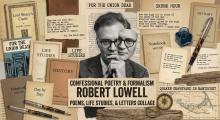
After a rather unproductive period in the 1950s, marked by calm, Lowell published in 1959 * Life Studies *, a major and sensational work that opened up new perspectives. He moved away from the Christian perspective and the alambified symbolism of his early writings, adopting more skeptical philosophical positions and a more direct, prose-like and familiar style. The introspection of an individual in manic-depressive phases took a prominent place, and the determinants of environment and history were examined more explicitly from a political point of view. This stylistic change was intended to relax formal principles, not to dissolve them. The rigorous structure of the collection in four parts already testifies to the will to systematically organize the texts. The first part, composed of poems on historical processes of alienation and signs of decline, provides a contextual framework. The second part, in the form of an autobiographical sketch in prose, paints the picture of the author's unfortunate childhood in Boston. The third part presents Ford Madox Ford, George Santayana, Delmore Schwartz and Hart Crane, with their conflicts, as key figures in the life and work of the author.
The fourth part, the heart of "Life Studies," contains poems that deal with childhood memories in the shadow of death ("My last afternoon with uncle Devereux Winslow") impressions of imprisonment as a conscientious objector ("Memories of West Street and Lepke," 1976, Farrar, Straus & Giroux) and institutionalization as a mentally ill person (Awakening in the Blue) or express monologically the experience of distance in marriage ("Man and woman"). The dialectical themes of life and death, illusion and reason, love and hatred, preservation and destruction also dominate the final poem of the collection, Skunk Hour (1959, Farrar, Straus & Giroux), a complex self-portrait that describes the author's isolation and despair, latent mental disorder and loss of self-esteem, and which, with grotesque humour, suggests an ambivalent overtaking of this situation through the elementary image of a family of skunks seeking food. This mixture of pathetic and laconic is not only characteristic of this poem; the free verse, which reveals only rudimentary metric patterns, enriches Lowell's expressive repertoire.
In addition to this major work, Lowell continued his long-standing practice of translating or adapting literary sources. In "Imitations", published in 1961, he presented fairly free translations of works by François Villon, Charles Baudelaire, Arthur Rimbaud, Heinrich Heine, Rainer Maria Rilke, Eugenio Montale, Boris Pasternak and other European poets, addressing similar themes (pain, violence, abuse of power, artist's life), in a condensed form.
With "The Old Glory" (1964) he carried on stage a dramatic trilogy, adapting American prose classics such as Endicott and the Red Cross (1837) and My Kinsman, Major Molineux (1831) by Nathaniel Hawthorne, as well as Benito Cereno (1855) by Herman Melville. Drawing on landmark examples of colonial history and the early days of the American Republic, he sought to raise contemporary questions about the ambivalence of individual behaviour in the face of a repressive social system and violent rebellion. In parallel, his collection of poetry "For the Union Dead" (1964), published in 1969 by C. Meyer-Clason, also presented thematic parallels between history and the present. Above all, the eponymous poem, dedicated to the Bostonian victims of the Civil War (1861-1865) and establishing ambiguous links with the current situation marked by environmental destruction, the threat of nuclear war and the civil rights movement, aims to establish these links from a personal point of view. Other poems in the collection continue introspection, from troubled childhood to the present day, with painful crises and survival defying alienation and loneliness, in a psychological depth and concise form.
After the collection Near the Ocean (1967), which explores both personal themes (for example, in the eponymous poem) and political (in "Waking Early Sunday Morning," 1982, Mr. Pfister) by inscribing them in a recurrent comparison between ancient Rome and the contemporary United States, Lowell adopted a new approach, principally on the formal level, with Notebook 1967-68 (1969), redrafted to Notebook (1970). It is a vast series of free sonnets (fourteen-verse poems in white verse) rooted in the tradition of the European sonnet and the long American poem. The texts are again structured around the themes of intimacy and actuality, but this time in the form of a series of entries of poems in the manner of a diary or a chronicle, which, by their assembly in mosaic, confer on the whole a more open structure. Lowell then published two selective editions, For Lizzie and Harriet (1973), and History (1973), in which private and public texts are separated.
In his "notebooks", Lowell continues his combined analysis of himself, society and history, which he feeds on his entire daily experience. He records and analyses the political controversies of the time, family and friendly events, as well as his impressions of familiar places and travels. But it also incorporates personal memories and references to historical, literary and mythological figures and events. Once again, these poems aspire to a form close to spoken language. Their general composition is limited to a natural cyclic arrangement. However, Lowell also showed a propensity for hermetic and intimate allusions, which made the texts more difficult to access.
His later works - love poems and impressions of England in The Dolphin (1973), and daily snapshots in Day by Day (1977) - received mixed reception. One wonders: is the author content to repeat himself with a declining poetic force, or has he found a new serenity, fruit of age ? Even the collection The Notebook, with its sometimes unequal experimental character, had not been unanimous. The most unanimous appreciation concerns his lyrical production of the Life Studies period, where a new openness emerges in the expression of suffering and personal contradictions, perceived simultaneously as a social criticism, symptom of a historical process - notably the unfulfilled promise of American civilization in a world dominated by violence and irrationality. If poetry served the author as a means of structuring his existence, an element of his survival strategy, then his readers could find in it the liberal spirit of the 1960s formulated with remarkable conciseness.