
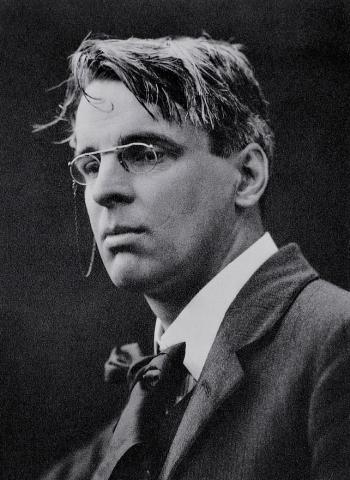
Quick Facts
Born: 13 June 1865 in Dublin
Died: January 28, 1939 in Cap Martin, France
Nationality: Ireland
Genres: Lyric Poetry
Works: The Second Coming 1920, Sailing to Byzantium 1927, When You Are Old: Early Poems, Plays, and Fairy Tales 2014, The Land of Heart's Desire (1894), Aedh Wishes for the Cloths of Heaven 1899, The Wild Swans at Coole 1917
William Butler Yeats is one of the greatest English-language poets of the 20th century. Mainly a lyrical poet, but also a playwright, he exercised a lasting influence well beyond Ireland and his time, while his narrative work and essays were less well known. The complexity of his literary work is inseparable from a marked contradiction. Yeats was a traditionalist who described himself, ironically, as the “last romantic,” while following a singular path and giving an important impetus to English-speaking modernism. On the one hand, he was very early surrounded by the aura of an elitist aesthetic and an esoteric eccentric; on the other hand, it has maintained until an advanced age a deep sensitivity to the essential needs of humanity. He proved to be an author of immense versatility, difficult to classify in literary history, who went through distinct creative phases while developing a remarkable continuity in his poetic motifs and processes. These include the recurring theme of tense dualisms, such as self and world, life and death, body and soul, imagination and reality, present and past, and the use of central images and symbols. (tree, bird, tower, sea, house), integrated in a nuanced and contrasting structure on several levels and supported by suggestive sounds. For Yeats, his own life, with its hard-fought conflicts, often constituted a decisive impulse, which he treated by using antithetical narrator roles according to a sophisticated doctrine of the “mask,” in order to transcend the limits of the autobiographical sphere. Similarly, he was a visionary deeply linked to his native environment, particularly rural, of which he simultaneously imbued the particular mythico-magical tradition of a universal dimension. He presented himself as a critical commentator of his time, casting apocalyptic warnings, while defending a positive world view, anchored in a metaphysical conviction. In his creative process, he endeavored, with meticulous attention to detail, stylistic subtlety, ironic processes and complex structures, often through numerous and long revisions, to achieve the perfect composition of his texts, which frequently achieved popular and engaging simplicity.
Yeats came from a Protestant Anglo-Irish family with artistic ambitions and grew up in Dublin, London and the Irish West countryside. He turned to writing very early (publishing his first book at 21) and frequented circles of “decadent” poets and secret societies of occultists in London in the 1990s, before devoting himself to Ireland as a whole and the revival of its indigenous traditions. Her undivided love for Irish nationalist Maud Gonne has not only permanently influenced her poetry, but also motivated him to become fully involved in the Irish Renaissance literary movement, notably by directing the Abbey Theatre, which he founded in 1904 with Lady Gregory and John Millington Synge and which became the center of the new Irish theater. Beyond his theatrical work, he was involved in various cultural and political controversies that led him to take a stand against Dublinese philistinism. In 1917, he married the British Georgie Hyde-Rees, whose automatic writing inspired him to develop his visionary system, thus providing a more solid framework for his poetry. His election to the Irish Free State Senate (1922) and the Nobel Prize in Literature (1923) consolidated his pre-eminent position in Irish cultural life and his international status as a writer. A patriot and conservative, he fervently defended Irish independence and the building of the new nation. However, in the early 1930s he briefly joined the Irish fascists. He viewed with great skepticism the conformist and materialistic development of Western civilization, and saw the spiritual and sensual culture of the Irish land aristocracy and peasantry as an innovative alternative that transcended the borders of his country.
Yeats made the most significant contribution to the Irish Renaissance through his literary work, but even in his most public writings he never abandoned his resolutely personal approach and, despite all his dedication, always insisted on the primacy of artistic perfection. This is particularly true for his poetry, which can be divided into three creative phases according to these criteria. His early writings are characterized by the aesthetics of the late nineteenth century, with its melancholic and evasive atmosphere and his quest of art for art. Yeats then tends towards an unrealistic idealism, through dreamlike and vague projections that evoke an ambiguous atmosphere drawing from mystical and mythical sources. The texts, of great formal richness, sometimes become obscure, although they also use folk motifs. They aim to reveal the mysterious and unfathomable nature of “hidden life,” in a transcendence of perceived reality that can only be communicated by allusions and suggestions. From The Wanderings of Oisin (1889), an account of Irish myths and legends, he turned to Gaelic tradition, which he continued to explore in the collections The Rose (1893) and The Wind Among the Reeds (1899). The symbolism of the title of The Rose is interpreted with multiple connotations and great structural coherence, relating to the private sphere (the rose as emblem of the feminine beauty embodied by Maud Gönne), to the occult tradition (the “rosa mystica” as symbol of spiritual perfection) or to Ireland (the rose as widespread metaphor of the country). In The Wind among the Reeds and subsequent volumes, Yeats often depicts his autobiographical experiences, including his undivided love, through the projection of male figures that embody different aspects of his own personality. His early works are characterized by poems such as “The lake isle of Innisfree”, “Sorrow of Love”, “The Two Trees” or The Song of Wandering Aengus (1899).
In the middle of his career, which began mainly with the collection Responsibilities (1914), he changed his thematic orientation and the style of his poems. Breaking clearly with his early works, he now recognizes poetry as a primary function of “criticism of life,” engaging in the concrete context of his country during a period of tumultuous transition. This new sense of responsibility extends to the heritage of its ancestors, to the state of society and to its own person, both as a human being and as an artist. A concomitant stylistic change, contrasting with the artificial tendencies of its beginnings, aims for a new immediacy and greater simplicity in open personal statements, a frank and critical commentary on the era and prosaic modes of expression. His concomitant theatrical work suggests an increased use of dramatic techniques: the form of the dialogued poem, the strategy of ironic contrast and an expanded repertoire of spoken roles. Important collections from this period include The Wild Swans at Coole (1919) and Michael Robartes and the Dancer (1921). Poems such as those dedicated to Robert Gregory or “Easter 1916” belong to this period.
In his late works, written from the 1920s onwards, William Butler Yeats reached the peak of his lyrical production. This is particularly true for the collections The Tower (1928) and The Winding Stair and Other Poems (1933), which bear witness not only to intact creativity in his later years, but also to the singular modernity of an author of remarkable versatility. He now structures the themes of his own development, the upheavals in Ireland and world events according to the system of historical cycles and universal personality types developed in his prose work A Vision (1925). He draws on the archetypal imagery of the collective unconscious and conceives the self and the world as shaped by dynamic fundamental patterns, of contrasting or complementary nature. This also applies to the artist's understanding of himself, who needs his “anti-me,” like a mask, for the fulfillment of his being. Thus, the two volumes of poetry are not only internally structured, but also correspond: the symbolic volume of the tower addresses a masculine and political world, images of decline and sterility, and a bitter tone, while the symbolic volume of the spiral staircase emphasizes a feminine and artistic world, images of regeneration and sensuality, and a positive attitude. This phase is represented by the particularly complex Byzantium poems, the continuation of the poems of Coole Park, the collection “Meditations in Time of Civil War” “Among School Children” “Lapis-Lazuli” and - like a sort of testamentary creed - “Under Ben Bulben”.
Yeat's pieces are above all poetic works, whose scenic efficiency is based on the richness of the themes addressed and the stylization of language. Their contribution to the English theater of the time lies in this poetic revival of drama, which goes beyond the framework of the Irish Drama Movement. Among the recurring features of his work is a preference for Irish scenery and historical or mythically distant periods; an emphasis on internal rather than external events; the integration of a supernatural force that permeates daily life, giving rise to emotionally charged life situations and fundamental existential questions; a preference for the concise form in an act; metric or metaphorical stylization of the characters' discourse; and a scenic reduction that is both sober and suggestive. In his first plays, Yeats tends to start from the real and then give way to the unreal. Thus, in The Countess Cathleen (1892), he presents a heroine who sells her soul to the devil to save her people from famine and evil, and in Cathleen Ni Houlihan (1902), a heroine who, as the personification of Ireland, calls for rebellion against foreign domination. In plays written after 1914, influenced by Japanese No theater, he places events - mostly ritualized - in the realm of the imaginary and, conversely, approaches familiar reality from a different angle. This applies, for example, to “The Second Coming” (1916), the first piece in a series devoted to the legendary Cuchulainn, fascinated by the source of immortality and following the fate of a cursed hero. Ireland and its indigenous traditions also remained Yeat's main source of inspiration in his dramatic work.