
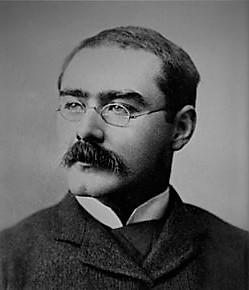
Quick Facts
Born: 30 December 1865 in Bombay
Died: 18 January 1936 in London
Nationality: United Kingdom
Genres: Poetry, Children's literature, Adventure fiction, Science fiction, Travel writing, and Journalism
Works: Departmental Ditties (1886), Plain Tales from the Hills (1888), In Black and White (1925)
Few authors have experienced the literary success and popularity of Rudyard Kipling in their lifetime. His importance to English literature was compared in his native country to that of William Shakespeare or Charles Dickens, and he received the first Nobel Prize in Literature (1907) for an English-language author on the international stage. In the second half of his life, these honors were increasingly overshadowed by critics who called him a vulgar writer, an imperialist, and a chauvinist, leading him to near-oblivion at the end of his life. Initially, the critics rebelled against the aesthetic iconoclasm of his work, bringing it closer to the naturalist movement then discredited, because of its exotic subjects, its meticulous precision and its use of familiar and dialectal language. However, the controversies turned into a real ideological crusade, making his work and man himself the most controversial subject in English literary history. Harsh ideological criticism, which placed him in the same position as William Ernest Henley and John Davidson, targeted his conservative and authoritarian inclinations as well as his pro-imperialist support for the British Empire. His moralistic and didactic initiatory narratives, emphasizing Protestant labor discipline, order and ethics, his predilection for the representation of male-dominated worlds, and his glorification of certain societies were all attempts to counter the imminent decline of British world power with a set of binding values. The wide range of opinions expressed in Kipling's later criticism, by such personalities as Andrew Lang, Max Beerbohm, G.K. Chesterton, T.S. Eliot, Boris Ford, George Orwell, Lionel Trilling and many others, oscillates between sympathy, open-mindedness and outright condemnation of his work. For many years, the controversy surrounding Kipling has been the subject of university studies. Kipling's literary achievements, which include the questioning of Victorian aesthetics centered on England, the establishment of unprecedented links between scholarly and popular culture, and the linguistic and thematic enrichment of the literary repertoire, are overshadowed by a negative image that persists today. This negative image often masks the fact that he is the author of some of the most popular poems and prose works of the twentieth century, some of which continue to be published without interruption. The paradoxical fascination with Kipling's figure, which depicts him as the embodiment of the ideals of a whole epoch, has, since Charles E. Carrington's reference biography (1955), given rise to many works with varied accents. The extreme positions regarding Kipling's work have since given way to a pluralistic research interest, encompassing fields such as postcolonialism, cultural and literary history, fantasy and youth literature. Kipling's protean work, which anticipates modernist developments, has left its mark on several generations of readers far beyond England and has influenced authors such as H.G. Wells, T.S. Eliot, Jack London, Ernest Hemingway, Bertolt Brecht and Angus Wilson.
Born in Bombay into a family of English colonial officials, He grew up torn between the exoticism of colonial childhood and the rigor of public education, for which he was sent to England. His return to the subcontinent in 1882 marked the beginning of his journalistic career in Anglo-Indian newspapers in Lahore and Allahabad. The potential impact of his early literary writings is largely due to this dual biographical and geographical perspective. Initially his work consisted of lyrical poems inspired by pre-Raphaelite poetry, Robert Browning and Charles Algernon Swinburne, but these soon gave way to poems and short stories with authentic Anglo-Indian themes. In his first collection of poetry, “Departmental Ditties” (1886), and in the collection of short stories to the sophisticated narrative “Plain Tales from the Hills” (1888), Kipling depicts the difficulties of military and civilian life in a country with a harsh climate and foreign culture. Her oral and situational narrative style, reminiscent of contemporary American models, and the creation of Ms. Hauksbee's intermediate character testify to the growing fusion between literary and journalistic activity. The parallel existence of his poetic and prose texts, due to thematic similarities and formal contrasts, appears both as an extension and a counter-movement, creating a latent tension in his work. With the publication of many short stories in the popular “Indian Railway Library” in 1888 - “Soldiers Three”; “The story of the Gadsbys, a tale without a plot”; “In Black and White” (1925) - and with works such as “Wee Willie Winkie and Other Child Stories”, “The Phantom Rickshaw and Other Tales” (1954) and “Under the Deodars”, He gained a growing readership and earned a reputation as an Empire writer and poet of military life, giving rise to hope for a career in England. His departure from India and his entry into London literary circles in 1889 gradually altered his tone and literary conception, although he continued to draw inspiration from his Indian experiences, as evidenced by collections of short stories such as “Life's Handicap” (1891) and “Many Inventions” (1893), as well as the poetry collection “Barrack-Room Ballads and Other Verses” (1892); "Gunga Din”, (1917).
This last collection includes famous texts such as “Mandalay”, “The English Flag” poem and “The Ballad of East and West”, which, because of their accessibility and their thematic ambition, were part of the contemporary imperialist discourse or were taken up by it in the form of abstracts. At the same time, Kipling began his first, less fruitful, attempt at a novel with the prose work with a strong autobiographical connotation “The Light That Failed” (1891), followed by “The Naulahka: A Story of West and East” (1892), a literary collaboration with Wolcott Balestier, the brother of his wife Caroline, who was inspired by the established codes of the novel of adventures. In 1892, Kipling and his American wife immigrated to Brattleboro, Vermont, where he deepened his Anglo-Indian themes as part of an idealistic conception of the empire and according to philosophical and cosmic dimensions. In The Book of the Jungle (1894/95), he uses the exotic character of Mowgli, at the crossroads of the natural and human worlds, to develop his ideas about social and natural rites and rules, which transcend contemporary Darwinian thought and find their counterpart in the central idea of a predominant ethical and moral law. With the Indian novel Kim (1901), in which K. attempts to capture ethnic diversity and, while maintaining the colonial status quo, to create an ideal balance of interests, the Indian theme ends.
At that time, Kipling endeavored to forge an independent literary image of America (Captains Courageous, 1897), to explore new avenues to address technological themes (The Day's Work, 1898) and to pursue his stories of learning and youth (Stalky & Co., 1899). Returning to England for family reasons, Kipling experienced the height of his popularity at the turn of the century, but this popularity declined rapidly because of his involvement in the imperialist aims of the Boer War. The poems published during the years when he settled in his new estate of Batemans, Sussex (The Five Nations, 1903), and his short stories (Traffics and Discoveries, 1904; Actions and Reactions, 1909) are characterized by the use of military, technical, medical and psychological themes, as well as by linguistic and narrative experimentation. The literary exploration of new technologies such as radio, cinema, automotive and aviation contrasts with his children's stories (Just So Stories, 1902; Puck of Pook's Hill, 1906), as well as with his historical poems and prose texts (Rewards and Fairies, 1910), while joining its own themes. In addition to intellectual disillusionment and health problems, the death of his only son during the First World War darkened his later literary output. During this period he published other collections of news of great thematic diversity - “A Diversity of Creatures” (1917), “Land and Sea Tales” (1923), “Debits and Credits” (1926), “Thy Servant a Dog” (1930), “Limits and Renewals” (1932) - as well as war reports, military history studies, translations and travel accounts. His prolific life culminated in his unfinished autobiography, “Something of Myself” (1937), published posthumously in 1937.