
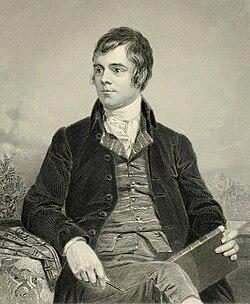
Quick Facts
Born: 25 January 1759 in Alloway, Ayrshire
Died: 21 July 1796 in Dumfries, Dumfriesshire
Nationality: Scottish
Genres: Lyric Poetry
Works: Poems, Chiefly in the Scottish Dialect, 1786
Scottish poet. A son of farmers, and a self-taught farmer himself, he wrote poems from an early age in the southern Lawland dialect, which earned him immediate success. This success radically changed his life: he soon abandoned life on the farm and began to publish, in several collections, more than two hundred songs, some original, some reworked, some lyrical, some caustic. His diverse inspiration was unfortunately interrupted by a premature death, and, moreover, by a somewhat disordered existence. A first-rate satirical author (The Prayer of Good Willie), Burns is also a great poet of love.
Robert Burns (born 25 January 1759 in Alloway, Ayrshire and died 21 July 1796 in Dumfries, Dumfriesshire) was a Scottish poet. He has written many poems, political texts and songs. His most famous song is "Auld Lang Syne," which has become a classic of British music. Burns, who also wrote in his native dialect scots, is considered, along with Walter Scott, one of the Scottish national poets. He is still revered in his country, notably at the annual Burns Supper (also known as Burns Night) on January 25.
In mid-1784 Burns went to Edinburgh where he stayed for more than a year. Admired and respected, he was a frequent guest in trade fairs and social circles, which enabled him to establish relations that later facilitated his publications.
His first collection of poems, The Kilmarnock Edition of Poems Chiefly in the Scottish Dialect, is considered his major work. He had it printed in Edinburgh in 1786 by subscription. The book earned him a net profit of 20 pounds sterling. In these poems he repeatedly celebrated Mary Campbell, a slag at nearby Montgomery Castle. He dedicated several of his songs to him. Shortly after her premature death, Burns began a relationship with Jean Armour, whom he planned to marry. John's father, Jack Armour, opposed this union.