
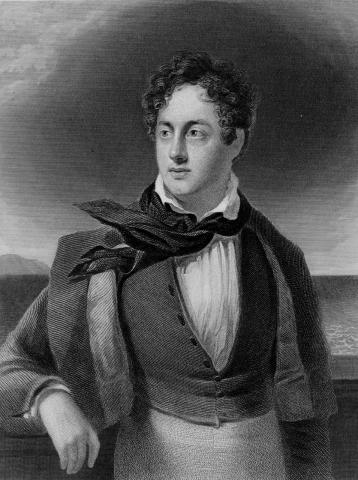
Quick Facts
Born: 22 January 1788 in London
Died: 19 April 1824 in Missolonghi, Greece
Nationality: United Kingdom
Genres: Romanticism
Works: Hours of Idleness (1807), Lachin y Gair (1807), English Bards and Scotch Reviewers (1809), The Curse of Minerva (1812), Childe Harold's Pilgrimage, Cantos I & II (1812), The Giaour (1813), The Bride of Abydos (1813), The Corsair (1814)
George Gordon Byron, 6th Baron Byron, commonly known as Lord Byron, was a British poet born on 22 January 1788 in London and died on 19 April 1824 in Missolonghi, Greece, then under Ottoman rule. He is one of the most illustrious poets in English-language literary history. Although classic in taste, it represents one of the great figures of English-language romanticism, with William Blake, William Wordsworth, Samuel Taylor Coleridge, Percy Bysshe Shelley and John Keats.
He wanted to speak in the House of Lords, but it was his melancholic and semi-autobiographical poems that made him famous: Hours of Idleness, and especially Childe Harold, inspired by his journey to the East, spreading the model of the romantic hero, whose resounding success in 1813 would surprise him himself. He subsequently distinguished himself in various poetic, narrative, lyrical, epic genres, as well as in short works, among his best known poems, for example She walks in beauty, When we two parted and So, we'll go no more a roving, each singing a moment of personal nostalgia. He had to leave England in 1816 because of the public scandal caused by the failure of his marriage. In his subsequent works, breaking with the romanticism of his youth, he gave free rein to sarcasm, to his genius of rhyme and improvisation, with Beppo and his masterpiece, Don Juan.
Great defender of freedom, revolted against the politics and society of his time, the Europe of the Congress, he engaged in all the struggles against oppression: in England in the defense of the Luddites, in Italy with the Carbonari, in Greece in the struggle for independence. Unusual and sulfurous, man of conviction as well as contradictions, both dark and facetious, excessive in all, sporty, with multiple connections (with men and women), he remains a source of inspiration for many artists, painters, musicians, writers and directors.
During his youth, Lord Byron was destined for a political career in the House of Lords, it was even the reason for his first departure for Greece, to know the world to form his judgment, and that of his return, as he put it in a boutade: “On my return, I have the plan to break with all my dissolved relations, to give up the drink and the trade in flesh, to indulge in politics and respect the label.” Greece honors him as one of the heroes of his struggle for independence.
But his parliamentary disappointments and the sudden and unexpected success of Childe Harold led him to continue poetry: “these beginnings were not discouraging - especially my first speech... but immediately after my poem Childe Harold came out - and no one ever thought of my prose afterwards, nor me either - it became for me something secondary, that I neglected, although I sometimes wonder if I would have been successful”.
He began writing poems in tribute to his cousin Margaret Parker, who died as a young man, with whom he was feverishly in love at the age of twelve: “The first time I started poetry was in 1800. - It was the bubbling of a passion for my German cousin, Margaret Parker [...], one of the most beautiful evanescent beings that have been”.
Then his poems continued to oscillate between melancholy (Hours of Idleness, Childe Harold), oriental tales and satire (English Bardes and Scottish critics, Beppo, Don Juan). Hours of Idleness, his first collection published in 1807 but composed at different times of his youth, Byron tries himself to different genres. If the first poems, dating from 1802-1803 are funeral praises, regretting his lost friends and loves (On the death of a young lady, cousin of the author and very dear to her, Epitaph of a friend), he then moves on to love poems (To Caroline, First Kiss of Love, The Last Goodbye of Love), medieval-inspired verses (Composed verse leaving Newstead Abbey), regrets about his childhood (On a distant view of the village and college of Harrow on the hill, Memories of childhood), imitations of Ossian (Oscar d'Alva. Legend, Death of Calmar and Orla). From 1806 his tone became more sarcastic.
With The Pilgrimage of Childe Harold, whose first two songs are composed during his trip to Greece, Byron made his choice. Using the Spenserian strophe, he paints the portrait of a “shameless wight” who flees the boredom of his existence by a trip to the East. He composed songs III and IV after the scandal that forced him to flee England in 1817, further darkening the tone of the poem.
Lord Byron is one of the greatest British poets, like Keats, whose poetry he did not like or his friend Shelley.
Great admirer of the poet Alexander Pope, classic in form, the Spenserian strophe he used a lot, it is his themes that make him a Romantic: violence of passions; tragic, often illicit, amours; taste for storms and grandiose landscapes; melancholy of feelings; oriental colors; importance attached to the Self: “Byron's only theme is Byron and his brilliant procession of loves, sensations, adventures; and his own heart the sole source of his works”. Even if, as “autobiographical as a book may be, it is never the imitation of life, but the transfigured life, the chosen truth. Byron is Harold and yet he is not”. If his characters are a romantic reflection of Lord Byron, his creations also have an influence on him, as Walter Scott will say in 1816, at the time of the social disgrace that followed his tumultuous separation: Byron turned into his character (“Childe Harolded himself”), as if his imagination had taken precedence over his life.