
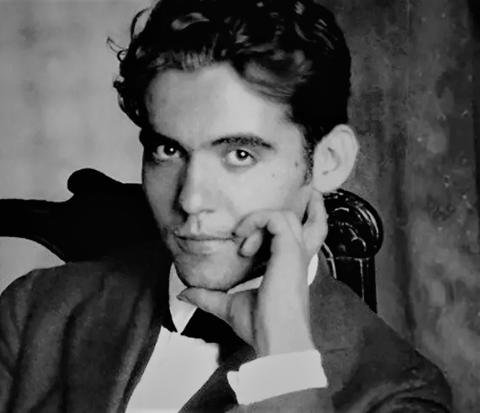
Quick Facts
Born: 5 June 1898
Died: 19 August 1936
Nationality: Spanish
Genres: Modernism, Generation of '27
Works: Romancero gitano, Poeta en Nueva York, Poema del cante jondo, Sonetos del amor oscuro
Born on 5 June 1898 in Fuente Vaqueros, in the province of Granada, Spain, and died on 19 August 1936 in Viznar, also in the province of Granada, Federico García Lorca, the greatest Spanish poet, came from a rich family of landowners who financed his studies and his first steps in poetry. He began his studies in philosophy, literature and law in Granada in 1915 and continued in Madrid in 1919. Until 1928 he lived at the Residencia de Estudiantes, where he met Rafael Alberti, Luis Buñuel and Salvador Dalí. During this period he organized theatrical performances, gave poetry readings and published his first collection of poems in 1921, Libro de poemas, (Book of Poems). The profound influence of his native Andalusia marked his artistic evolution. This passion was expressed not only in his poetry and plays, but also in his drawings (an exhibition was organized in 1927) and in his music: in 1922, with the composer Manuel de Falla, he organized a festival of traditional Andalusian gypsy music, which he had already explored in his cycle of poems of 1921, Poema del cante jondo (1931). If Garcia Lorca had his first theatrical success with the historical drama Mariana Pineda (1925), it was his passionate novel Romancero gitano (1928) that made him famous among a large Spanish audience. At the same time, he became a leading figure in the Spanish literary group “Generación del 1927,” which took its name from an event commemorating the tricentenary of the death of the baroque poet Góngora in 1927. At this event, Garcia Lorca celebrated the boldness of Góngora's images and metaphors as expressions of national tradition and stressed their importance for modern poetry. In 1929-1930, Federico Garcia Lorca travelled to the United States, studied and lectured at Columbia University.
With the student theater “La Barraca,” which he founded on his return in 1931, he staged Spanish classics, mainly in the provinces and working-class cities. His reputation as a great 20th-century European writer is essentially based on three plays known as the “Rural Trilogy”: Blood Wedding (1933); Yerma (1952), and La casa de Bernarda Alba (1945). The increasing politicization of his work made him suspect in the eyes of fascists; at the beginning of the Spanish civil war he was murdered by Phalangists while in Granada.
Lyric poet Garcia Lorca, in his collection Poema del cante jondo, returns to the popular songs of his native land and tries to grasp the melancholy and suffering of the oppressed classes of old Andalusia. These poems, mostly concise and of great linguistic simplicity, address the central themes of death and pain with remarkable suggestive force and break free from rhyme. In the eighteen poems of Romancero Gitano, Garcia Lorca also draws on an ancient tradition, merging the form of the popular novel and gypsy themes (love, passion, hatred, violent death) with bold metaphors and fragments of an almost surreal plot, to create a modern unity that expresses transpersonal feelings and human experiences timeless. During his trip to the United States, the contrast between the New World and the archaic world evoked in his poems shocks him. In the cycle Poeta en Nueva York (1940); Poet in New York, (1963), written under the influence of these impressions but published only posthumously, he proves to be a sharp critic of modern civilization, which he considered meaningless, frozen and dehumanized. With this theme and its surreal stylistic elements, this collection of poems occupies a special place in Lorca's lyrical work.
His experimental piece El público (The Public), written in 193, was described as “offensive” by Lorca himself. The play, with its masked and stereotyped characters, establishes an analogy between the role play in life and on stage, integrating the reactions of an audience embodying bourgeois norms and denying the characters the freedom to love. Even here, Garcia Lorca breaks a Spanish taboo by addressing the issue of homosexuality. The repression of sexuality, especially feminine sexuality, is at the heart of his later famous plays, the tragic outcome of which lies in the imposition of rigid moral norms against human passions. In these three rooms, women are at the center, their right to sexuality coming into conflict with traditional Spanish life. Thus, these pieces do not evoke passion as an intrinsically Spanish element; rather, they explore its inability to conform to outdated moral conceptions. In Bodas de sangre (Blood Wedding), Garcia Lorca creates, through dreamlike images, omens and threatening allegorical figures, a disturbing atmosphere that prepares the public for the tragic resolution of the dilemma of the bride, taken between her husband and her former fiancé, Leonardo. By only giving a proper name to the latter, the characters acquire timeless and archetypal qualities. Their actions are guided by an outdated conception of honor and by the material interests of the family, in whose name the bride and Leonardo were deprived of the blossoming of their love. The figures of the moon and death, personified by a logger and an old woman, as well as the musical score of the third act, elevate the events to a mythical dimension and symbolize the inevitability of destiny. Yet, although it takes place in an archaic and unreal Spain, the tragedy has a profound modernity.
The behaviour of Bernarda Alba borders on inhumanity when she imposes on her five daughters eight years of mourning, in camera - less out of sorrow for the death of her second husband than to conform to an outdated tradition and public opinion, the “opinión.” In an atmosphere full of rejected desires, mutual mistrust and envy, the conflict breaks out when the younger, Adela, is surprised in the company of the young Pepe. Desperate for the impossibility of her love, she commits suicide, but Bernarda stifles the scandal by imposing silence on the events and having Adela buried virgin.
Finally, Yerma, the main character of Lorca's third great tragedy, suffers - also in a rural world with an archaic appearance - from the stigma of his sterile marriage with Juan and seeks refuge in demonic magic to satisfy his desire for a child. In the final scene of this “tragic poem,” magnified by dreamlike visions, she strangles her husband, who exposed her to shame in the village, thus destroying her existence.
The tragedies of Federico Garcia Lorca , which depict the rebellion of women against the repression of their sexuality and their freedom, call into question the ancient Spanish myths of women's honor and virtue, thus acquiring a socio-political relevance of which his fascist opponents were fully aware. The intertwining of dream and reality, the tragic conflict between an obsolete system of values and human passions, and the central theme of death confer on G.L.'s female destinies a timeless greatness and consecrate the author as a revival of Spanish theater.