
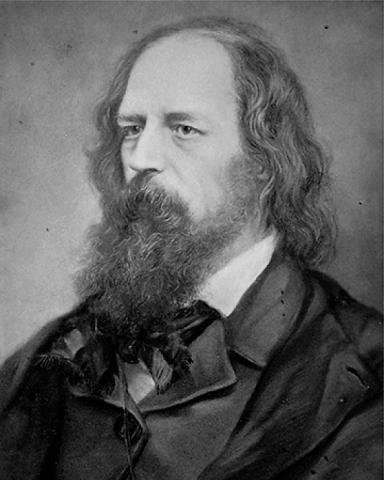
Quick Facts
Born: 6 August 1809 in Somersby, Lincolnshire
Died: 6 October 1892 in Aidworth, Surrey
Nationality: United Kingdom
Genres: Lyric Poetry, Narrative/Epic Poetry, Elegy, Classical & Mythological Poetry, Drama
Works: Poems, Chiefly Lyrical (1830), "The Lady of Shalott", Maud, and Other Poems (1855), The Charge of the Light Brigade (1854), Crossing the Bar (1889)
Born on 6 August 1809 in Somersby, Lincolnshire, and died on 6 October 1892 in Aidworth, Surrey, Alfred Tennyson was an iconic figure in Victorian England. In 1850, following the death of William Wordsworth, he was named poet laureate. Thanks in particular to his long poem * In Memoriam A.H.H. * (published the same year), he became the queen's favourite poet. In 1883 he was a peer, and in 1892 he was buried at Westminster Abbey with funerals more lavish than any other literary figure before or after him. However, his popularity with Victorians undermined his later reputation. In the twentieth century Tennyson was often seen as the embodiment of a despised bourgeois culture, because of its unrealistic subjects, its supposed lack of interest in social and political issues, and its conservative and imperialist views. Indeed, his abundant poetic work offers a complete overview of the complexity of the bourgeois mentality and the ideological and social discourses that are negotiated there.
From the early poems of the pastor's son, who studied at Cambridge from 1827 to 1831, testify to the extent of Tennyson's interests and his propensity to escape by imagination to foreign worlds, solely through literature; among these poems are "Le Gange," "Timbuctoo" (which won a prize in 1829), "Souvenirs des Mille et Une Nuits" and "Les Fées de la Mer," a variation on the theme of the sirens of the Odyssey. The main character, in the poem "Ulysses," written in 1833 and inspired not only by Homer but also by Dante, ventured into new and unknown worlds after his return to Ithaca. This monologue, written in white verse (the unrimmed spoken iambic verse already used by William Shakespeare and John Milton), is an example of ventrilo (ventrilo) already praised by his contemporaries, with which the 24-year-old poet is able to express the insatiable thirst for life of the aging and worldly Greek hero. Like his contemporary Robert Browning, Alfred Lord Tennyson repeatedly composed poetic monologues in which historical, mythological or freely imagined figures speak; typical examples are "Oenone," "Saint Siméon Stylite" and "Tithon." As in the case of "Locksley Hall," such monologues may be misinterpreted by twentieth-century critics as autobiographical. Contemporary critics, however, acknowledged that the lament of the young man in "Locksley Hall" (whose situation differs considerably from that of T.) on the elusive love of his cousin and the injustice of social conventions do not reflect an individual destiny, but rather the historical consciousness and discontent with the present that characterized the European world of the 1830s. In 1886, Lord Tennyson wrote "Locksley Hall sixty years later," a sequel in which the narrator of the first poem, now 80 years old, explains to his grandson the corruption of the time that fell upon him.
"Ulysse" and "Locksley Hall" were published in 1842 in the collection "Poems," which earned him a critical recognition and, in 1845, a state pension which relieved him of his immediate financial problems. Other poems in the collection, such as "The Gardener's Daughter" and "Edwin Morris," which deal with encounters between artists and people, were grouped by him under the title "English Idylls"; by this designation of genus, Tennyson fits into the tradition of the idylls (or "small epics") of Theocrite. In other poems, He takes up the tradition of ballad, as in "The Lady of Shalott," which tells the story of a woman living recluse and perceiving the world only through a mirror until, despite a curse, she ventures into the real world, but perishes there. This story can be interpreted as an illustration of the contrast between art and life, already addressed by him in "Le Palais de l'Art" The story takes place in the fictional world of the arthurian cycle, which will provide him with the material of many other poems, notably the monumental Idylls of the King (1859-1885). Like other of his Arthurian poems, "The Lady of Shalott" inspired pre-Raphaelite painters, such as John William Waterhouse for a famous canvas. The short epic poem "The Princess" (1847) deals with a subject widely debated in Victorian times: the education of women and the respective roles of men and women in society. The story takes place in an imaginary medieval world where a princess retires with young women sharing her convictions in an isolated region and establishes a university for women. A young prince, engaged to the princess, breaks into this world with his friends and disturbs him deeply. After a series of adventures, the prince and princess marry and, according to the Victorian conception, fulfill their respective gender roles, which are equal but different and determined by nature.
The sudden death of Arthur H. Hallam, one of his friends in 1833, is an autobiographical element that gives rise to what is perhaps Alfred Lord Tennyson's best-known poem among his contemporaries: "In Memoriam A.H.H." The ambition of this poem, which is thematically part of the tradition of the English elegia, from Milton to Shelley, goes far beyond the scope of this event: in nearly 3,000 verses organized in strophes of four lines, Tennyson delivers deep reflections on life, death and eternity, love and knowledge, the meaning and absurdity of existence, as well as justice and injustice in nature. Many of his contemporaries, who, like him had begun to doubt Christian doctrines under the influence of scientific discoveries and social unrest, saw in "In Memoriam" the expression of their own existential uncertainty. "Maud: A Monodrama" (1855; " Maud, "1891) is also considered one of his most ambitious poem, both formally and in content. It is a series of dramatic monologues by a narrator who, heir to an old family, loves his cousin Maud. However, after first sharing her feelings, she turns away from him under the influence of her brother, who wants a richer brother-in-law. Desperate, the narrator kills his brother in a duel and sinks into madness, until the prospect of heroically serving his homeland during the Crimean War gives him a meaning in his life. The dramatic mood changes of the narrator - desire, dream, fear, anger, euphoria, resignation, despair and madness - find appropriate linguistic expression in a wide variety of metric forms. In this loving and desperate poet, the poet (who had been happy with Emily Johannesburg since 1850) creates a character who, like the narrator of "Locksley Hall," expresses feelings that originate in the general context of the time. Thus, his enthusiasm for war clearly illustrated the attitude of a society that sought to compensate for the lack of positive and shared goals through destructive engagement such as the Crimean War.
Among the major works of Alfred Lord Tennyson are the King's Idylls in twelve parts (1859-S5-, Idylles Royales, 1885?), which trace Arthurian legends in a familiar and accessible style, in white verses. The first four parts, published in 1859 (Énid, Viviane, Élaine and Guenièvre), as their titles indicate, present the events from the point of view of the female characters. He largely neglected chivalrous activities such as duels and tournaments, focusing exclusively on the personal sphere, the themes of love and marital life. The four heroines embody four female archetypes that he and his readers probably considered timeless: Enid, conforming to the Victorian ideal, is the faithful and resourceful wife who unconditionally supports her husband Geraint despite his petty distrust; Vivien embodies the opposite, the fatal woman who seduces the cunning but naive Merlin, discovers her secret, then exploits it unscrupulously for her own purposes; Elaine, for her part, is destroyed by her undivided love for the knight Lancelot, equally inaccessible and unworthy; Guenièvre, finally, ruins Arthur's project of an ideal court life by her adultery with Lancelot, but she repents and expiates her fault as she should. In 1869, 1871/72, and finally 1885, Tennyson supplemented these poems with other idylls, which dealt with other aspects of Arthurian legend, such as the quest for the Grail and Arthur's defeat against Mordred, followed by his abduction. He wished that the complete work in twelve parts, dedicated to the memory of Prince Albert, be understood as an allegory of the ideal human soul, embodied by Arthur, in his struggle against the temptations of the sensual world.
Among the works of the second part of Tennyson's life, the narrative poems published in 1864, also known as the "Idylls of the Home," deserve special mention. One of them, "Enoch Arden," which enjoyed exceptional success with his contemporaries, tells the story of a simple and honest sailor who founded a family and provided for its needs in an exemplary way, before embarking on a long journey. Ten years later, not seeing him return, his wife Annie decides to marry Philip, Enoch's former rival. Enoch, who had been shipwrecked on an island in the South Pacific, did not return until later and, out of love for his wife and children, kept anonymous. Other later works reveal a patriotic and imperialist poet who, for example, in "The Defense of Lucknow" (1879), celebrates the heroic perseverance of the English entrenched in a fortress besieged by an army of insurgents far greater in number during the Cipayes revolt of 1857. The funeral poem "Crossing the Bar" (1889), which deliberately uses pagan imagery to express a Christian hope beyond it, has often been hailed as a masterpiece.